

Modern SaaS buyers don’t want another feature list. They want to see how your product solves their problem, in the right order, with just enough context to say “this is for me.” That’s where a guided product demo shines, and why growth teams are shifting away from static landing pages toward more structured interactive demo pages.
What is a guided product demo page?
A guided product demo page leads a visitor through your product story step by step. Instead of a long, scrollable page packed with features, it choreographs the sequence, context, and conversion moments. The visitor doesn’t just read about the product; they move through it.
In practice, a guided demo page:
- Sets a clear beginning, middle, and end to your product narrative
- Surfaces cues, prompts, and visual highlights at the right time
- Aligns each step to a micro-conversion (e.g., “Watch flow,” “Try feature,” “Book a call”)
- Reduces cognitive load by revealing only what’s relevant next
With xdreality, that orchestration is the point. You build a defined path for room tours, virtual showrooms, 3D product pages, or interactive experiences, then tune the sequence to match how your best reps sell.
Why static landing pages stall
Static landing pages are useful for explanation, but they often fail at momentum. Visitors skim, jump around, and miss the thread. The page might be beautiful, but the story is out of order and the next step is unclear.
Where static pages break down for SaaS:
- Sequence is left to chance: The buyer chooses their own order, which rarely aligns with your most persuasive narrative.
- Context collapses: Feature blocks float without the setup that makes them meaningful.
- Call-to-action fatigue: Multiple CTAs compete, producing clicks but not commitment.
- Low intent signals: Time on page and scroll depth don’t reveal what actually resonated.
If your product has depth—multiple personas, complex workflows, or a novel UI—leaving the journey open-ended often means your most convincing points never connect.
Guided product storytelling, explained
The core idea is simple: design the experience around a clear path. In xdreality, that path isn’t just a clickable prototype. It is a guided flow with guardrails and intentional detours when they add value.
Core principles of a guided flow:
- Narrative order: Lead with the problem, then the critical aha, then the supporting features.
- Timed cues: Use annotations, hotspots, or lightweight prompts at the exact moment they matter.
- Progressive reveal: Only introduce complexity once the core value is locked in.
- Micro-conversions: Place lightweight commitments—continue, save, share, book—at natural breakpoints.
- Visual memory: Anchor key moments with distinctive visuals, like a focused 3D view or a short interaction.
A guided product demo page becomes a product storytelling page that feels consultative, almost like a top rep walking a qualified prospect through the app. You control the storyline without losing interactivity or agency.
Designing your guided flow (and where interactive 3D helps)
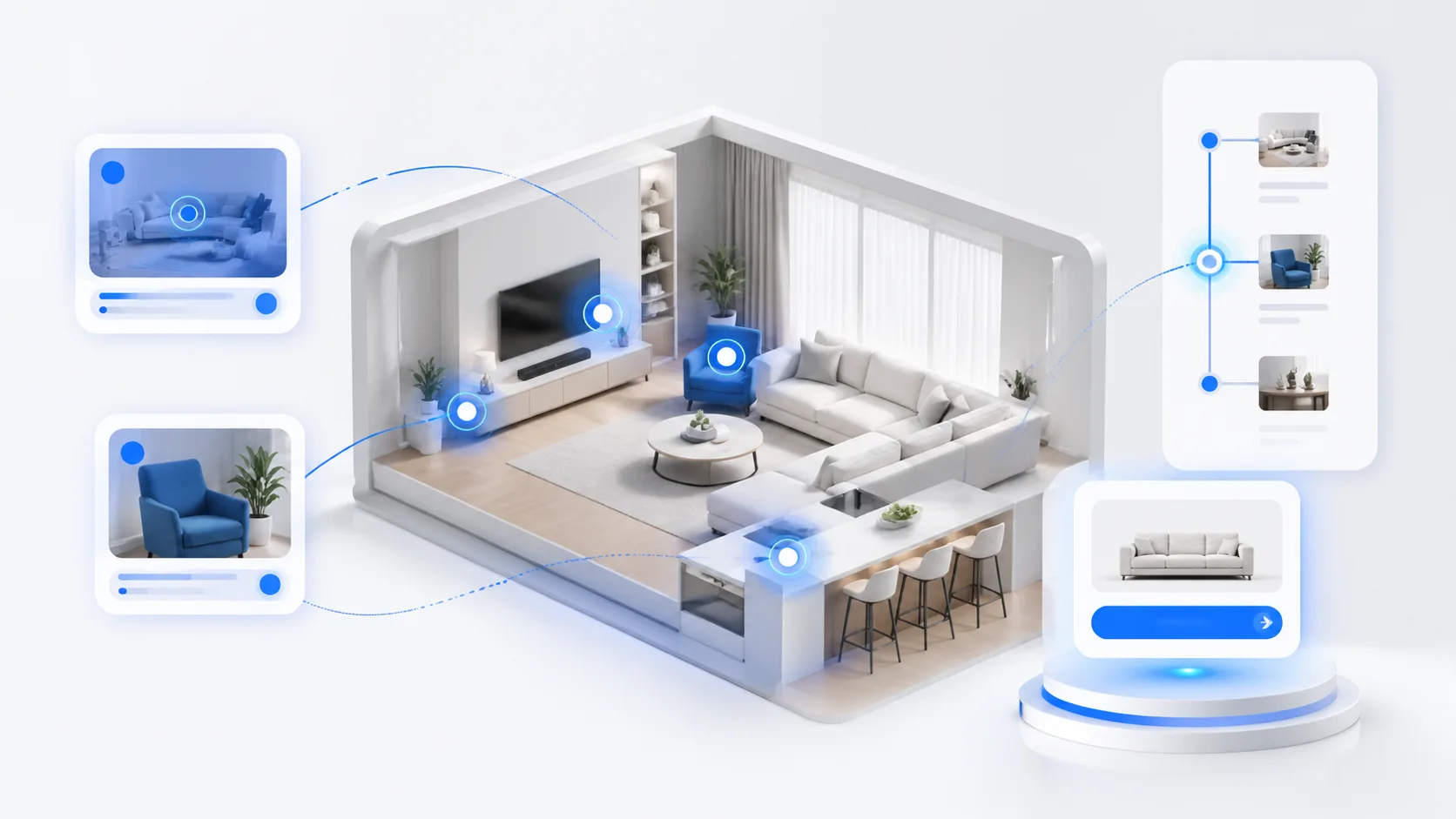
You don’t need a complex spec to get started. Anchor your flow in the moments that consistently move prospects forward in sales conversations.
Start with these steps:
- Define the protagonist: Who is this path for—admin, end user, or exec? One route per primary persona outperforms a catch-all page.
- Choose your aha: Identify the single moment that best demonstrates value. Build toward it.
- Map your beats: 5–8 steps is usually enough. Label each step with its job-to-be-done and the cue you’ll use to make it land.
- Plant micro-conversions: Add small commitments—continue, copy link, request sample data, book a call—aligned to intent.
- Close decisively: End with a crisp decision—talk to sales, start trial, compare plans—based on what they just saw.
Where interactive 3D elevates the story:
- Room tours: Perfect for complex systems where spatial context clarifies architecture or workflow.
- Virtual showrooms: Ideal for packaging multiple modules or SKUs in one navigable canvas.
- 3D product pages: Let visitors examine states, transitions, and system relationships—not just static screenshots.
- Guided interactive experiences: Mix UI previews, motion, and context to cement understanding.
A guided, interactive product demo page is the static landing page alternative when clarity depends on order, context, and feel, not a wall of text.
Conversion moments you can control
Static pages treat CTAs as afterthoughts. Guided demos turn them into plot points.
Plan for three layers of commitment:
- Low-friction: Continue, replay step, jump to summary, share with a teammate
- Mid-intent: Save configuration, request a tailored walkthrough, unlock a deeper route
- High-intent: Start trial, book a meeting, request pricing conversation
In xdreality, you decide exactly where these moments appear within the flow. Tie each to a specific beat: right after the aha, at a comparison node, or beside a risk-reversal element. Because the sequence is defined, you reduce guesswork about when to ask and why it works.
Signals that matter to growth teams
Guided flows turn vague engagement into interpretable signals. Instead of hoping a long-scroll page correlates with interest, you can observe how people move through the story.
Useful signals to watch:
- Flow completion: Who reached the final step, and where do drop-offs cluster?
- Step dwell time: Which beats create healthy pause (curiosity) vs. confusion (friction)?
- Cue interactions: Which annotations or hotspots earn attention and which are ignored?
- Conversion alignment: Which micro-conversions follow specific beats (e.g., after the aha)?
- Path variants: How a persona-specific path performs against a general baseline
Because the narrative is intentional, these signals tell a real story about message-market fit, not just page consumption.
Fitting guided demos into your funnel and stack
Guided product demo pages are versatile. Growth teams deploy them where a static landing page struggles to persuade.
Common placements:
- Top-of-funnel education: Replace a generic feature page with a guided overview that leads to a trial or lead form.
- Mid-funnel qualification: Give SDRs and AEs a single link that warms prospects before or after first contact.
- Product-led onboarding: Route new users through the aha and first setup, shortening time-to-value.
- Executive recaps: Provide a condensed, narrative-driven artifact champions can share with stakeholders.
With xdreality, you can build:
- Room tours that show how systems, roles, or environments connect
- Virtual showrooms that package modules into persona-specific routes
- 3D product pages that reveal states and transitions, not just features
- Guided interactive experiences that mirror your best sales narrative
The throughline is control. A guided approach lets marketing, sales, and product marketing align on one story, one sequence, and measurable conversion moments, all inside a single experience.
Static page or guided demo? A quick decision lens
If you’re deciding between a traditional landing page and an interactive product demo page, use this lens:
- Choose static landing page when the message is simple, the audience is broad, and the goal is quick scanning.
- Choose guided product demo when order matters, context makes or breaks understanding, or you need stronger pre-qualification.
If your top reps rely on a particular sequence to close deals, your marketing shouldn’t tell a different story. A guided demo page is the marketing equivalent of your best sales walkthrough: repeatable, scalable, and tuned for conversion.
How xdreality makes guided demos practical
xdreality is built for room tours, virtual showrooms, 3D product pages, and guided interactive experiences. Growth teams use it to:
- Control the sequence: Lock in the order that mirrors your winning sales narrative
- Place cues with intent: Add prompts, highlights, and context exactly where they belong
- Stage conversion moments: Insert micro- and macro-CTAs when the visitor is most ready
- Build once, reuse everywhere: Share a single guided link across ads, email, sales outreach, and docs
The result is a product storytelling page that doesn’t just inform—it moves people. Visitors understand how your product works, why it matters, and what to do next.
Ready to replace your static landing page with a guided product demo? See how a guided demo page can improve sales conversations with xdreality.